Saturday, April 26, 2014

What Some Moroccans Want You to Know About Moroccan Culture


            On Thursday night, my site mate and I ran a round table discussion with some of my more advanced students about the Peace Corps, why some Americans (like us) feel compelled to do it, how it benefits America, how it benefits the host countries, and its three goals (developmental assistance, spreading awareness of American culture abroad, and increasing American knowledge about other cultures). Depending on which PCV you ask, and when, anyone of these goals might be the most important. At different points in my service I’d have answered differently. My students universally felt that the cultural exchange elements of the second and third goal were far and away more important than the first goal. As such, to finish up the discussion I posed this question to them, “what is the one aspect of Moroccan culture you think it is most important that I share with other Americans when I go home?” Below are their answers.

Loubna said that honor and respect are central to Moroccan culture.

Yassin, Scherazade, and Aicha all think I need to teach people what I learned about Islam.

Youseph added that it is important to remind people that Morocco is primarily Muslim and that means that it is strongly anti-terrorist.

Kamal, who spoke first, said that I should teach people about Moroccan food, but he regretted his quick answer when he realized most of the other students were going to make more serious points.

Moustapha didn’t learn from Kamal’s mistake and later regretted that he’d used his answer to say I should teach Moroccan dance.

Nabil on the other hand did learn from them and said that I should talk about Moroccans deep love of peace.

One of the two Merriams said that I should talk about tea and the importance of drinking it in a group.

Nouhela said that I should teach about Moroccan holidays.

Abdelghani said that Morocco’s is a culture in flux, in the midst of developing into something new.

The other Merriam said that it is important to remember that Morocco doesn’t just have one culture; each city has its own.


Our next session with these students is Tuesday. If you have any suggestions of important aspects of American culture we should share back with the students leave them in the comments below, or, if any of my Moroccan readers want to add to this list feel free to do so in the comments.

Thursday, April 24, 2014

How to Wrap Up a Peace Corps Service (I Think)


            This has probably been the very hardest post to start writing of my entire service. As you might expect, with less than two weeks left in my site before I head first to Fes (to visit my original host family), then to Rabat (to officially sign out), and lastly to AndalucĂ­a (for a couple of weeks of R&R), this is a pretty emotional time. Bittersweet is the go to adjective, but it hardly does justice to how I feel, because while I’m excited to get back to America and on to the next stage in my life the immense realization that I’ll probably never see most of my students and Moroccan friends again overwhelms the excitement and almost makes me wish I was extending my service just to spend time sitting in cafes and eating meals with them. As such, I’ve spent a lot of the last few weeks trying to spend quality time with as many people as possible, which is surprisingly exhausting, but does lead to some great stories.

            A couple of weeks ago a couple of sisters in my adult beginners class invited me over to their house for cous cous. As always happens, it turns out they’re related to a bunch of people I know in town, none of whom ever mentioned that they were related—I didn’t even know these two students were sisters until the family members lesson! The topics of conversation ranged all over, from one of the sister’s ill-fated attempt to teach herself guitar, which ended with her mother smashing the “racket making device” after just two days (her mother looked pretty embarrassed at this point in the story), to the distinction between anime and other cartoons. This came up because their ten-year-old brother flip-flopped back and forth between two animated channels, each showing one or the other. He was very excited I was there, and was very proud of the English words he learned over lunch. Their mother cooked an astonishingly good batch of cous cous, and showed off her weaving skills on an impressive loom stored in a side room. The conversation almost took a turn for the disastrous when the topic hit the almost inevitable “do you pray” question. One aunt, who has emigrated to Italy but was back visiting, started telling us all that in Italy she knows many Muslims who are, in her words, “better Muslims” than Moroccan women. These Muslim women in Italy always hide their hair and never shake men’s hands. Her nieces, who are in their twenties, only rarely cover their hair and have never hesitated to shake my hand, nor did her sister, or herself, in fact, so I objected to her saying that the Italian Muslims were “better” Muslims, arguing that neither way was better, just different. I started to argue that no version of a faith is better than another, all Islams are true Islam, just as all Christianities are true Christianity and all Judaisms are true Judaism. Then I stopped and revised myself, if people believe their version of faith to be so right that they kill others for it they believe a false version of the faith, so that Al Qaeda operatives and the Afghani Taliban are not Muslims at all, just as a man who murders for Christianity is not a true Christian, and a man who murders for Judaism is not a true Jew. Except for the aunt, who looked miffed, and the ten year old, who was engrossed in a knockoff version of Full Metal Alchemist, the family applauded. Which was cool.

            A couple of days later was the start of the school holiday. Since most of the students with whom I’m closest were going back to their outlying villages for the holiday or were travelling around Morocco, and since my Dar Chabab is still being repaired (the new floor goes in soon!) I decided to use the opportunity to go to a few nearby places were I’ve made friends to say my goodbyes. First, I went down to my friend Melanie’s site, were she has gotten yet another set of toilets built in the elementary school in an outlying village. Just like last time she did this (just before I went home in December) she had PCVs and local high school volunteers put on a health fair for the students. I partnered with one of her students, who had also gone to BRO camp, teaching an exercise lesson to the little kids. A passing herd of cows temporarily disrupted us, but otherwise the fair went very well and I was glad for the opportunity to say goodbye to those students of hers I’ve met and gotten close to over the last two years.

            The next day I was in Khenifra to help the volunteers there with their spring camp. They’d decided that instead of an English focused camp this time around we would teach about art in various forms: drawing, painting, music, theatre, and dance. I helped primarily with the music, teaching the students an American song everyday and one day also teaching them the harmonies to “In the Jungle,” my first successful attempt at getting harmony going among Moroccan youth. My favorite part of the camp was a group of local volunteers. A friend from my site who is a fantastic painter came in and helped the kids plan and paint two canvases for the “Global Art Exchange.” These canvases, on the topic of world peace, will go to an American high school (in Colorado, I believe), and in return the Khenifra Dar Chabab will get a piece from that school. On another day, some men who run a performance art association came and taught the kids a dance to Katy Perry’s “Roar” (yeah, I was confused as well), and helped the kids write a couple of short theatre sketches.

            On the last day of camp the students, many of whom I’ve gotten to know well through various camps and events I’ve helped with, threw a surprise good-bye party for me. It was incredibly sweet and incredibly sad. Afterwards a few kids wanted to say a few words about the camp, and one kid's speech was incredibly touching. He said, in English, that we Peace Corps Volunteers “are like angels, coming from far away just to help us fill our empty time, time we didn’t know was so important until you came.” It was a really hard day not to cry.

            The next day I stuck around Khenifra to join on a hike with those volunteers’ C.L.I.M.B program, which ended up meaning I saw most of the same students again. We went up a mesa outside of town that I’ve been meaning to climb for whole service, so it was great to finally get up there. In a nice twist the grade and quality of the slope is actually very similar to Toubkal (read: steep and covered in scree), so I was able to tell the students from experience that it was good practice for Toubkal. Just multiply it by 10 or 11 times.

            The next day was this past Monday and I am back to my regular schedule in site, the only big differences being that I spend even more time trying to hang out with folks and that I spend a lot of time helping my new site mate learn about town and meet people. She is doing very well integrating and is already a huge hit with my students, and I’m excited to know that even though I’m wrapping up my own service, my students are not wrapped up with.

Saturday, April 5, 2014

Assumptions


            I haven’t written a post on the vagaries of Arabic in some time, but this last week I made a discovery so mindboggling I can’t help but write about it. A few weeks ago I played “Blackbird” for my sophomores as a listening exercise. Since we’d been talking about metaphors in previous classes I was very happy that they quickly realized that the song is not about a bird. They got pretty close, actually, saying it was about some person who didn’t have freedom or opportunity before but now had a chance for it. This led us to talking a little bit about the Civil Rights Movement (my 30-minute spiel in simple English with Darija clarifications on the Civil Rights Movement still needs work), which they knew absolutely nothing about. This has put us on a kick talking about social issues in Morocco and on racism. Keep in mind that at the beginning of the year these kids couldn’t say “hello” and still only have a tenuous grasp on the past tense, though they kill in the present and present progressive, so we’re not talking high theory here.

            Keeping on this topic, last week I said an English word they’d never heard before. Assumption. “Younes,” they asked, “what does ‘assumption’ mean.” Realizing that I actually didn’t know it in Arabic, I defined assumption as something you believe without having a reason to believe it. Then I asked them how to say it in Arabic. They thought for awhile. Then they thought some more. Their eventual conclusion was that there simply wasn’t a word for it in Arabic. I found that a little hard to believe, but we moved on and they used it correctly for the rest of class. Since their first language is Tamazight, I decided I’d ask one of my English-speaking friends whose first language is Arabic what “assumption” is.

            He’d never heard the word before. So I explained it to him the same way I’d explained it before, giving examples of bad assumptions (an American who has never lived in an Arab country or met any Arabs might think all Arabs are terrorists, or boys in Morocco often assume girls who dress “loosely” are asking to be harassed) and good assumptions (if the next town in one direction is the same distance away as the next town in the other we can assume that it takes the same amount of time to drive to one or the other, but even this can be wrong because one might be uphill and the other down). He said that this was an entirely new concept to him, but that good assumptions could be covered by a certain word, however as we talked more about that word it seemed like the better translation was “conjecture.”

            Still unsatisfied I took to the Internet. On Facebook, Peace Corps Morocco has a group where PCVs can ask each other and various LCFs, tutors, and other English speaking Moroccans language questions. I explained that the word had come up in class and how I’d defined it. The first response from one PCV was this: “ ‘something you believe without reasons’ is oftentimes ‘fact’ here.” Rather flip, but sadly often rather accurate as well, which is part of the reason I want to talk about assumptions with my kids. Another enterprising PCV got an answer from Google translate, but we wanted confirmation. Another PCV suggested that since there isn’t much of a cultural context here for it just to go with “beliefs” or “opinions,” but I still wanted an answer. Eventually one of the Moroccan group members chimed in. His response was laughter. So as far as I know, there is no word for assumption in Arabic (any Arabic speaker reading this please comment and let me know if I’m missing something here).

            Now, this might be assuming too much (yeah, I groaned as well, but it was too easy), but I wonder if part of the problem the first volunteer brought up, that things you believe without reason are oftentimes “facts” here is because they don’t have a word for assumption. There is a lot of distance between fact, not fact, and outright false, and assumption is an important concept bridging that distance. Maybe I’m reading too much into the limits of language, reading Orwell too much at an early age will do that to you.

            In other news, a couple of weeks ago I was in Rabat for my Close of Service Conference. There isn’t really too much to write about it here, but it was an interesting and reflective time. Really highlights how close to the end I am. In fact, I realized, I have no more than 6 sessions left with any one class at this point. Less with some of them. Hopefully, most of those sessions won’t be solely mine anymore either, providing the bus system follows through the volunteer who is to replace me in site should be arriving later today!

            To finish up I’ll put in a Joha story since I haven’t in awhile. This is one of the ones I’ve used in play form in class, in this case with my freshmen to follow-up on their lesson on clothing:

            One day, Joha went to a shop that sold clothing. There he saw a beautiful pair of pants that he wanted to buy. After haggling for a good price the shopkeeper started to wrap up Joha’s purchase.
            “Wait,” said Joha, “I actually think I like that coat better, how much is it?”
            “For you,” said the shopkeeper, “I’ll say the same price as the pants.” Joha thanked him and took the coat. “Wait,” cried the shopkeeper, “Joha, you haven’t paid me.”
            “I’ve left you the pants,” replied Joha.
            “You didn’t pay for those either,” said the shopkeeper.
            “Of course not,” said Joha, “why would I pay for something I didn’t buy?”

Tuesday, March 11, 2014

The BRO Code


            The last week of February was probably one of the busiest and most meaningful weeks of my service. As I mentioned a few posts ago, a fellow volunteer down in the Beni Mellal area had been planning a camp to teach boys life skills and how to be honorable men, and I had the opportunity to help out with this important project. He called his idea BRO (Boys Respecting Others) Camp, and modeled it on the Peace Corps standby GLOW (Girls Leading Our World) camps that have been enormously popular and successful with female PCVs and Moroccan girls. This was the first camp of its kind for boys in Morocco, and I’m glad to say it was a great success, mainly on the strength of the organizing PCV’s tremendous efforts beforehand and the passion of his fantastic Moroccan counterparts.

            On a day-to-day basis, BRO camp had a packed schedule. Each of the five full days centered on one topic important to growing up to be a good man. The first day focused on health and healthy life styles and in the morning featured classes on topics like exercise, hygiene, nutrition, drugs and alcohol, and emotional health. In the afternoon the students made and preformed informational skits on one of the topics they’d studied (all the groups chose drugs and alcohol), and in the evening a doctor gave a talk about SIDA and sexual health. On the second day we focused on the world of work, with classes in interview skills, resume writing, goal setting, and the like. That afternoon students created commercials to sell a fictional product or service.

On the third day we started hitting the harder topics and approached gender. The morning classes got the boys discussing gender stereotypes in Morocco, the different worlds of men and women here, how to be an honorable man, and, of course, sexual harassment. Afterwards a couple of Peace Corps’s female regional managers came in and gave a talk about their lives as successful, independent women in Morocco, which the boys seemed to find riveting. Later in the afternoon the boys went through what we called “The Gauntlet of BRO” (since “gauntlet” doesn’t really translate in Arabic we called it the only slightly less awesome “Competition of Honor”). In the Gauntlet of BRO small groups of boys cycled through different rooms in the camp where they were faced with a common situation and expected to recognize the situation and respond as an honorable man would. In one room the teacher came late, the students hopefully spotted the loose change on the floor and reported the missing money (almost all groups did, and no one stole it). In another a couple of teachers ordered them about to serve tea and biscuits, without any ‘pleases’s, ‘thank you’s, or recognition at all. In the discussion afterwards the groups all realized that this is how a lot of Moroccan men treat their wives, sisters, daughters, and mothers, and having now experienced it vowed to try and behave better. Another challenge had students making requests and seeing if they would say “please” and “thank you” themselves (this was only partially successful, mainly because they found tasks they were asked to ask the tester were rude requests to make). The last two rooms both involved bystander intervention. In one a Moroccan co-teacher “accidentally” brought in the wrong supplies and got chewed out by the PCV, students were expected to stop the “fight.” In the last the PCV (me) stepped out of the room in the middle of a silly ball game. The game was the “bait,” and after I stepped out came the “switch,” a female PCV walked in and my Moroccan co-teacher pretended to harass her. This was probably the most depressing room, because although all the groups recognized the harassment only two stepped in to stop it. Interestingly, they did it in markedly different ways. One group actively called out the teacher. The other subtly invited the girl to join the ball game, and then put her as far from her harasser as possible, which I thought was a very clever solution to dealing with this issue with an authority figure. In the evening the boys put on skits about different forms of sexual harassment and methods of intervening.

The fourth day was all about teamwork and leadership. The morning classes were on topics like public speaking, project planning, and community organizing. In the afternoon a local business leader gave a talk and then we took the boys on a nature walk, where we occasionally stopped and threw in exercises like the human knot and trust falls. In an unplanned twist, at the last moment we decided to make the whole thing an exercise in discipline. Earlier in the week, one of the other PCVs had taught the boys how to stand at attention, on the hike we taught them to march, occasionally called them to attention, and even doled out pushups. Surprisingly, or perhaps not, the boys really enjoyed the strangely paramilitary exercises. On the last day, we taught about community service and the boys participated in a trash pickup. The speaker was the local delegate to the minister of Youth and Sports, who talked about the importance of volunteerism.

Throughout the camp, the boys worked in teams on a project called the Build a Better Morocco Competition (BBMC). In this project the students picked an issue in the Beni Mellal province (topics included: lack of transport to schools, unemployment, and the high high school drop out rate, among others), researched that issue, and tried to come up with a youth based solution to the problem. The presented these on the last day, an impressive capstone to the camp. The BBMC was actually a big part of the camp’s success. In addition to the points their team could earn in the competition we also rewarded, or removed, points for team actions throughout the camp, things like doing their chores (we had a rotating cleaning schedule), helping out, and behaving particularly well (or poorly). It really helped to build team spirit in their cohorts, and to keep everything running smoothly.

Now, this all makes the camp sound very serious, but of course all these things were interspersed with regular camp activities like sports and games and banging on drums. One day one of the PCVs who hails from the American South even taught the kids a line dance. Sort of. Since he didn’t remember an actual one he sort of made it up on the fly, but the boys enjoyed it. One thing I found very interesting was how much more faith based this camp seemed than any other I’ve worked in Morocco. Part of this, I think, was that the Moroccan counterparts were a particularly devout group, and since they were often making time for their prayers the boys decided they would too (in one particularly beautiful moment a large group prayed together on top of the mountain on the nature walk). The other part could be that instead of saving their prayers for the end of the day, as often happens at camps, the boys didn’t have girls to flirt with, and without distractions decided to pray at the prayer times. In any case, it was probably the most systematic I’ve seen the practice of faith here.

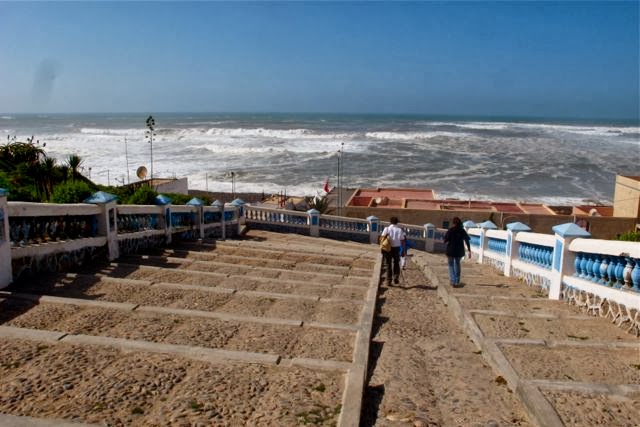
After the camp was over and the boys all marched (of their own volition this time) to the taxi stand I was very happy with how it had gone, though very exhausted and sick. I actually came down with a flu the last couple of days, and had to miss the community service day and only just trundled myself out in a blanket to watch the BBMC presentation. Since the week after school breaks is always slow back in site, and since this would be my last chance to travel in Morocco, I went down to recuperate in Sidi Ifni, a beautiful seaside Spanish colonial town from the 1930s built in a wonderful art deco style. I don’t have too much to say about it, other than that it was incredible and relaxing, but I’ll finish off this post with some pictures of it. For now I’m back in site, my flu mostly passed, and I’m excited to get back to work finishing out my last two months in the Peace Corps!