Tuesday, August 27, 2013

European Escapades and their Consequences


            It has been a while since I last wrote.  To be honest it has been quite hard to write because I’ve been pretty feeling pretty low since coming back to Morocco from my Ramadan trip to Europe.  The trip to Europe was absolutely fantastic and a welcome break from life in the developing world, but coming back has seriously highlighted some of the intense issues that Morocco must face in order to move beyond this developing stage.  Since this is a blog about Morocco the majority of this post will be about these issues, rather than a blow by blow of the trip and the camp I worked in Khenifra upon returning.

            Chief among the issues facing Morocco is harassment in its many forms, religious, political, and sexual.  One of the best parts about being in Europe was simply liberation from constant scrutiny, judgment, and pressure to live differently.  Not once did I feel uncomfortable for being a different faith.  Since coming back I’ve had to readjust to people constantly asking if I’m Muslim and then pressuring me or even trying to trick me into converting when I say I’m not.  Someone even told me that the Christian faith I profess was evil and ugly.  This lack of tolerance and harassment of the different puts a severe check on the forward movement of the country. 

While in Frankfurt I had the fortune to meet two young men from Cairo.  They were both very left thinking and were supporters of the military coup, which they did not feel was a coup (this was before the massacres in early August).  They were both secularist Muslims, and as such were intensely against the Islamist government, which they felt had repressed even moderate Islam in favor of a more fundamentalist approach.  They felt that they weren’t safe in the streets, one had even received death threats for wearing his hair long, and his mother was threatened for not wearing hijab.  Since the men threatening them were fanatics the boys were convinced the government would not pursue justice against them, and that put their lives in danger.  The upshot of all this was that they’d felt dehumanized, and from there they dehumanized their oppressors.  They seemed incredibly angry at the Islamist and didn’t seem to care one way or the other if the military used violence against them.  To me this shows the dangers of intolerance; these boys hadn’t had their differences tolerated, and now in turn when their side was in power they saw no problem in repressing their former repressors.  I tried to talk with some Moroccans about this, but my conversation with actual Egyptians about Egypt was dismissed in a wave of Islamist fervor.  The wouldn’t accept that Mr. Morsi hadn’t done a good job maintaining his democratic mandate, and because they felt more compelled to say their beliefs as truths then to listen to my different (and thereby necessarily wrong) ones they couldn’t understand that I liked neither the Morsi government nor the coup.  Rather than listen to another point of view people shoot it down and attack the person saying it.  This is a product of the dichotomizing effect of harassment.

There is another form of harassment endemic to Morocco which severely damages its tourist industry.  This is the constant attempt by many Moroccans in touristic areas to prey on tourists.  One of the truly great things about Morocco is how welcoming, kind, and helpful Moroccans are.  One of the truly terrible things about Morocco is how a significant minority of people will attempt to cheat tourists by faking this helpful and welcoming attitude up until the point that they can get the tourists in a bind.  While standing at a map in London trying to get our bearings we talked about how nice it was to not have dozens of young men throwing themselves at us trying to drag us away from the map so they could take us somewhere and charge us a service fee for doing it.  The upshot of course is that in Morocco there wouldn’t even be a map, and the young men would just try to drag you to the popular tourist places, where you actually want to go be damned.  It’s frustrating, annoying, and if there are women in the tourist group possibly traumatizing as the young men harass them.  After almost three weeks of not having these kinds of issues it was really disheartening when our first experience with Moroccans as we left the airport was a bunch of men agreeing to a fair price for a taxi back into the city and then trying to raise it once we got into the taxi.  These actions hurt the tourist industry, which could otherwise be a major shot in the arm for the economy.

The other major issue that this trip threw into relief is the inequality between the sexes.  While there is still a ways to go in both America and Europe towards full gender equality, compared to Morocco the disparity is very small.  It felt safe going out at night with the girls in our group, and we saw women doing all kinds of things that they cannot do in Morocco.  Perhaps the most surprising and strangest thing I noticed in Europe was that it was equally interesting to talk with women and men in our hostels and in the cities.  In the camp I worked at back in Morocco I noticed that, as always, I tended to find the girls much more interesting to talk to then the boys.  Also, unlike in Europe, the young women’s English, on average, is notably better than the young men’s.  I think that this problem is a direct result of gender inequality.  Since the boys face so many less challenges they tend to work less hard, meaning that the girls, in general, have better English, greater drive, more informed view points, and a wider range of interests.  This is, of course, a gross generalization, and there are many exceptions but in the younger generation it is largely true, and would probably be true in older generations if not for the higher levels of repression that kept women from attaining higher (or any) education.

I was hoping to end this post on a positive note, but I’m having a very hard time writing it.  I think instead I’ll just mention that although I’m having pretty negative feelings about Morocco of late the trip was an inspiration to redouble my efforts at development work with my students here.  In the coming year I hope to especially work in two areas, giving students more opportunities to explore their interests, be they art, music, sports, theatre, or what have you, and working with students on issues of gender equality.  If possible I’d like to do this by helping the boys understand the importance of respecting girls and of engaging and working hard, like the girls do, but should that fail with the boys here I’ll instead focus on giving the girls more opportunities to develop their talents and interests.  So I guess in conclusion I escaped to Europe, and as a consequence now want to work even harder.

Thursday, July 18, 2013

Ramadan Report #4 (Questions of Faith)


            It’s hard to believe, but I’ve been here long enough that I’m now in the middle of my second Ramadan.  Like last year, I decided that I would participate in the fast, at least for the parts where I’m in the country, though since I got sick early on I haven’t been keeping it very strictly, especially with regards to water.  This isn’t really cheating, you are not supposed to fast when you’re sick, in fact you’re breaking the rules if you don’t eat while sick.

            Last year I found that Ramadan was a time when people wanted to talk about faith a lot, and this year is the same.  It has seemed to me that for whatever reason a lot more people don’t like that I’m fasting without being Muslim this year than last year.  While the vast majority of people I’ve talked to still like that I’m participating in this part of their culture, a vocal minority never fails to say that my fasting doesn’t count since I’m not praying.  Another minority (sometimes the same people, sometimes others) has been trying to get me to convert.  This happens pretty much constantly through the year, but during Ramadan even more would-be missionaries come out.  I get asked a lot about why I’m a Christian, why I don’t pray, and why I don’t believe.  A lot of times my responses, which are that Christianity is the faith I grew up with, and that Christians do pray and believe, aren’t accepted, which is unique to Ramadan.  Thankfully sometimes other people will jump in and tell the questioners to stop jumping down my throat.  To be honest, it can be annoying but I don’t really mind, I know they’re asking and trying to convert me because they care and want me to go to heaven.

            One day while I was on the way to break fast, one of the town’s old men called me over to talk.  I don’t know this man’s real name; everyone just calls him El-Hajji, an honorific for someone who has made the pilgrimage to Mecca.  El-Hajji has never actually made the pilgrimage.  He earned the honorific through his intense study of the Quran and Hadith, and is one of the town’s Imams (prayer leaders).  El-Hajji wanted to teach me a little about Islam, and maybe convert me.  It was an interesting conversation, even if he was only successful in teaching me.

            He started out by talking a little bit about how God keeps track of our actions.  He said that each of us has two angels who always travel with us, one to our right and the other to our left.  The angel on the right writes down all our good actions, the one to the left records the bad.  On the Day of Judgment they will read both lists back to us.  Then he changed tacks a bit and asked me if I knew what happened in Egypt.  Surprised, I said of course I knew all about the coup, but he said no, not that, and then started to tell me a story.  It took me a minute to realize it was Moses parting the sea.  He followed this up with a few other miracles.  Then he told me about all the unpleasant things that happen to someone in Hell, a fire and brimstone sermon that would rattle John Edwards (not the one of recent political fame).  Then, after asking if I was circumcised, he described the process of prayer and invited me to come to the mosque for Friday prayer some week to learn more.  It was quite the tour-de-force, though the shock and awe approach to conversion wasn’t the right tack to convince me.

            Otherwise not too much is going on, but I wanted to post because in less than a week I’ll be flying to London for my first out of country vacation since arriving last March!

Tuesday, July 9, 2013

Creating Leadership In the Mountains and Beyond


            This past week was definitely the high point of my service thus far.  This was the week when, after six months of preparation, we finally made the trip down to Mt. Toubkal, the tallest mountain in North Africa, with my C.L.I.M.B. students.

            Toubkal is 4,167 meters (13,671 feet) tall.  It takes two to three days to summit and return to the base.  A daunting task, and one my students handled with their usual aplomb and spirit.

            We left my site on the last day of June to travel down to Marrakech and then immediately onto Imlil, the village at the foot of the mountain.  It was a long day, made longer both in actual time when the bus came an hour late and in exhaustion when the waiter at the food stand we stopped at on the way down tried to pull a fast one and double the price of lunch when he realized the American had all the cash.  Once all gathered in Imlil we were an impressive group, 14 students (the 15th in the club had a family event he couldn’t miss), two Moroccan teachers, two other PCVs who came to help out, and myself.

            The first day of climbing we went from Imlil to a refuge about a kilometer and a half below the peak.  The first day is a long, steep ascent, but the students had tons of energy and the hardest part for me was restraining the fastest boys from running up the mountain in their excitement.  We met some other American hikers on the trail, who you’ll see later in the story become very important.

The Refuge in Imlil
Imlil

The two girls who hadn't wanted their photos online say they've changed their minds, which means now I can post group shots!


            At the refuge we rested and recuperated with other hikers, some of whom had done the same climb we had and others who had summited that day.  One group was another student group, this one of British middle school students who were on the most awesome field trip of all time.  Their leader, an ex-military guy turned school teacher, has done extensive climbing in Nepal, so leading a group of 13 year old school kids up this peak wasn’t actually that over the top for him.  I was extremely impressed, though also a little jealous of their British public school discipline, especially when it came time for lights out.  I wouldn’t change my students for the world, but it was a reminder of one reason (besides money) that Western students tend to have more frequent and more awesome field trips than Moroccan students.  It’s way less of a logistical nightmare with students who’ll keep to a timetable.

            At the start of the second day we had a frustrating revelation.  Despite our constant reminders to bring cold weather cloths for the top three students had decided not to bring them.  The worst part, they actually had lugged jackets on the trip, but without asking us leaders had left them with some other luggage we were stowing in Imlil since it had seemed so hot at the foot of the mountain.  In good conscience we couldn’t let those three climb, so we had to leave them behind.  I guess we should have done another gear check as we started climbing the first day, but this was a mistake I hadn’t expected.

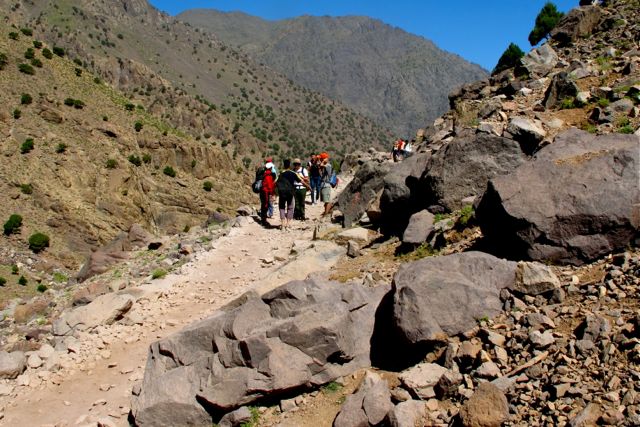
            So with eleven students and five teachers we started the difficult second day’s ascent.  It starts with a steep scree slope, and except for a couple of boulder fields continues in that vein for the whole way up.  It’s an exhausting climb through barren, black mountains that recall the entrance to Mordor.  The wind was howling most of the way up.  Still we pushed through, though at a pretty slow pace.

The Refuge on the mountain


The peak finally in sight!


            At the very beginning of the day we caught up with a group of extremely unprepared Moroccan hikers.  They were wearing very little, and carrying almost no food and water.  When we saw them they were taking a very dangerous and difficult route straight up the scree, and I had to stay behind a second to help guide the last one in the group down to a safer path with us.  The others refused to try the easier route.  The guy who did come with us eventually went on when we took a break so he could catch up with the friends who’d abandoned him.  He must have caught up at some point, because when I next saw him he had a bottle of water.  He also had lips and nails slowly turning blue in the early stages of hypothermia and his friends had abandoned him again.  Sending the kids forward to a safer ledge to take a break I opened up one of the safety blankets I’d brought and pulled out some nuts and raisins for him to snack on.  I looked ahead and was very happy to see the two American girls we’d met the day before chatting with our group ahead, coming back from an earlier summiting.  Since I’d learned the day before that they knew what they were doing I had no concerns asking them to help the man down, especially since he had pretty good English.  He was lucky they were there to take him down safely.  I was lucky they were there so that I didn’t have to forego my own summiting to bring him down.

            This Moroccan group was not the only group of fools on the mountain.  One German sounding family had brought their kids, neither of whom could be older than eight, who looked absolutely miserable as we passed them.  An Australian man came galloping down the mountain and was lucky not to twist his ankle when he tripped and fell.  All in all I guess it was good for my students to see how much they’d learned, how they knew what not to do, but the amount of dangerous practices I saw on the mountain was staggering.

            The very last part of the ascent is extremely slippery scree, made all the worse because at that point I at least was starting to feel the lack of oxygen.  We had to stop every few minutes to let ourselves catch our breaths, so it was a hard push, but eventually, just as the wind died, we were able to reach the very top.  The view is spectacular, and since the winds had finally gone down we ended up having lunch up at the very top of Morocco.  The kids now have bragging rights for life.


Our group, with some random dude sleeping in the way (we think he's the dude who abandoned the other guy lower down)


Me and my counterparts

Peace Corps Volunteers


The further town is Imlil

Kids with a Geocache
            Going down is also a tricky operation, especially since we’d never been able to practice descending a scree slope, but the kids did a fantastic job and we were able to break up our trip by finding a geocache someone had hidden about half way up the mountain.  The students were shocked to learn that some hiking obsessed Westerners play a game hiding things on mountain and leaving GPS coordinates for others to find, but were really excited once we’d found the cache.  We returned afterwards exhausted but accomplished.

            On our third day on the mountain we walked back down from the refuge to Imlil.  Once there we discovered the innkeeper with whom we’d left our stuff with was in Marrakech, two hours away.  We called her up, and I got permission to climb up a few tables and enter a high, open window, successfully burgling our own stuff from an inn I had permission and ability to enter only through the most ridiculous means possible.  A fitting end to our time on the mountain.


            After my flirtation with a life of crime we went back to Marrakech, a city I was surprised to learn almost half my students had never visited.  We took them through the raucous street theatre that is the main square and split into small groups to explore the souks.  The group I was with somehow stumbled on a shop full of antique Jewish artifacts, so now I can say I’ve explained the purpose and history of the menorah to a bunch of Moroccan students in Arabic.  Afterwards we had dinner and fresh squeezed orange juice under the stars back in the main square.

            When I told my students we wouldn’t be leaving until the following afternoon they rushed me in a football scrum of hugs.  For a second I wondered if they registered the bit where I told them we were doing this to give us time to visit an historical monument.  We took them to the Bahia palace, a place I’d visited with my parents but which even most of the students who’d been to Marrakech had never seen.  As with any group of teenagers in an historic site about half were really interested while the other half were bored out of their minds, but it was still a good trip and I’m glad I finally got a chance to make history a little more tangible for the kids.


            All in all, this trip to Marrakech and Toubkal was fantastic and easily the highlight of my service.  Since then a couple of students have told me it was the greatest thing that they’ve ever done, which I guess means I can go ahead and say I’ve had a successful Peace Corps service, regardless of what else I can get off the ground.  The Sunday after getting back to site we had an after party where the students told us how much they’d like to keep the club going, even in a non-funded form, to learn more about the environment and to keep doing local hikes together.  I’m glad I’ve had this chance to work with such a great group of kids, watching them grow both as individuals and as a team, as leaders and as good followers, and I hope to keep working with those who aren’t going to university next year, but for now we have to take a little break.  Ramadan has come.