Tuesday, March 11, 2014

The BRO Code


            The last week of February was probably one of the busiest and most meaningful weeks of my service. As I mentioned a few posts ago, a fellow volunteer down in the Beni Mellal area had been planning a camp to teach boys life skills and how to be honorable men, and I had the opportunity to help out with this important project. He called his idea BRO (Boys Respecting Others) Camp, and modeled it on the Peace Corps standby GLOW (Girls Leading Our World) camps that have been enormously popular and successful with female PCVs and Moroccan girls. This was the first camp of its kind for boys in Morocco, and I’m glad to say it was a great success, mainly on the strength of the organizing PCV’s tremendous efforts beforehand and the passion of his fantastic Moroccan counterparts.

            On a day-to-day basis, BRO camp had a packed schedule. Each of the five full days centered on one topic important to growing up to be a good man. The first day focused on health and healthy life styles and in the morning featured classes on topics like exercise, hygiene, nutrition, drugs and alcohol, and emotional health. In the afternoon the students made and preformed informational skits on one of the topics they’d studied (all the groups chose drugs and alcohol), and in the evening a doctor gave a talk about SIDA and sexual health. On the second day we focused on the world of work, with classes in interview skills, resume writing, goal setting, and the like. That afternoon students created commercials to sell a fictional product or service.

On the third day we started hitting the harder topics and approached gender. The morning classes got the boys discussing gender stereotypes in Morocco, the different worlds of men and women here, how to be an honorable man, and, of course, sexual harassment. Afterwards a couple of Peace Corps’s female regional managers came in and gave a talk about their lives as successful, independent women in Morocco, which the boys seemed to find riveting. Later in the afternoon the boys went through what we called “The Gauntlet of BRO” (since “gauntlet” doesn’t really translate in Arabic we called it the only slightly less awesome “Competition of Honor”). In the Gauntlet of BRO small groups of boys cycled through different rooms in the camp where they were faced with a common situation and expected to recognize the situation and respond as an honorable man would. In one room the teacher came late, the students hopefully spotted the loose change on the floor and reported the missing money (almost all groups did, and no one stole it). In another a couple of teachers ordered them about to serve tea and biscuits, without any ‘pleases’s, ‘thank you’s, or recognition at all. In the discussion afterwards the groups all realized that this is how a lot of Moroccan men treat their wives, sisters, daughters, and mothers, and having now experienced it vowed to try and behave better. Another challenge had students making requests and seeing if they would say “please” and “thank you” themselves (this was only partially successful, mainly because they found tasks they were asked to ask the tester were rude requests to make). The last two rooms both involved bystander intervention. In one a Moroccan co-teacher “accidentally” brought in the wrong supplies and got chewed out by the PCV, students were expected to stop the “fight.” In the last the PCV (me) stepped out of the room in the middle of a silly ball game. The game was the “bait,” and after I stepped out came the “switch,” a female PCV walked in and my Moroccan co-teacher pretended to harass her. This was probably the most depressing room, because although all the groups recognized the harassment only two stepped in to stop it. Interestingly, they did it in markedly different ways. One group actively called out the teacher. The other subtly invited the girl to join the ball game, and then put her as far from her harasser as possible, which I thought was a very clever solution to dealing with this issue with an authority figure. In the evening the boys put on skits about different forms of sexual harassment and methods of intervening.

The fourth day was all about teamwork and leadership. The morning classes were on topics like public speaking, project planning, and community organizing. In the afternoon a local business leader gave a talk and then we took the boys on a nature walk, where we occasionally stopped and threw in exercises like the human knot and trust falls. In an unplanned twist, at the last moment we decided to make the whole thing an exercise in discipline. Earlier in the week, one of the other PCVs had taught the boys how to stand at attention, on the hike we taught them to march, occasionally called them to attention, and even doled out pushups. Surprisingly, or perhaps not, the boys really enjoyed the strangely paramilitary exercises. On the last day, we taught about community service and the boys participated in a trash pickup. The speaker was the local delegate to the minister of Youth and Sports, who talked about the importance of volunteerism.

Throughout the camp, the boys worked in teams on a project called the Build a Better Morocco Competition (BBMC). In this project the students picked an issue in the Beni Mellal province (topics included: lack of transport to schools, unemployment, and the high high school drop out rate, among others), researched that issue, and tried to come up with a youth based solution to the problem. The presented these on the last day, an impressive capstone to the camp. The BBMC was actually a big part of the camp’s success. In addition to the points their team could earn in the competition we also rewarded, or removed, points for team actions throughout the camp, things like doing their chores (we had a rotating cleaning schedule), helping out, and behaving particularly well (or poorly). It really helped to build team spirit in their cohorts, and to keep everything running smoothly.

Now, this all makes the camp sound very serious, but of course all these things were interspersed with regular camp activities like sports and games and banging on drums. One day one of the PCVs who hails from the American South even taught the kids a line dance. Sort of. Since he didn’t remember an actual one he sort of made it up on the fly, but the boys enjoyed it. One thing I found very interesting was how much more faith based this camp seemed than any other I’ve worked in Morocco. Part of this, I think, was that the Moroccan counterparts were a particularly devout group, and since they were often making time for their prayers the boys decided they would too (in one particularly beautiful moment a large group prayed together on top of the mountain on the nature walk). The other part could be that instead of saving their prayers for the end of the day, as often happens at camps, the boys didn’t have girls to flirt with, and without distractions decided to pray at the prayer times. In any case, it was probably the most systematic I’ve seen the practice of faith here.

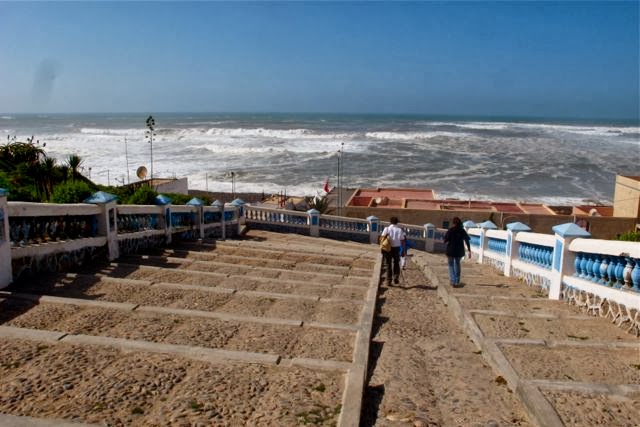
After the camp was over and the boys all marched (of their own volition this time) to the taxi stand I was very happy with how it had gone, though very exhausted and sick. I actually came down with a flu the last couple of days, and had to miss the community service day and only just trundled myself out in a blanket to watch the BBMC presentation. Since the week after school breaks is always slow back in site, and since this would be my last chance to travel in Morocco, I went down to recuperate in Sidi Ifni, a beautiful seaside Spanish colonial town from the 1930s built in a wonderful art deco style. I don’t have too much to say about it, other than that it was incredible and relaxing, but I’ll finish off this post with some pictures of it. For now I’m back in site, my flu mostly passed, and I’m excited to get back to work finishing out my last two months in the Peace Corps!


Tuesday, February 18, 2014

Breaking the Silence


            Despite a disappointment at the end of the week, last week is easily a contender for “Best Week of My Service.” Starting last Sunday, everything just seemed to be going right, I had a great time at a student’s family’s farm, I had some good and productive meetings with counterparts, another great lunch at the Khenifra volunteers’ host family, two great classes with my sophomores, where they wrote their own English plays, a great discussion with my juniors, all the other classes running very smoothly, and weather finally getting warm and sunny enough to spend a lot of time playing Frisbee with various age groups in the park. The capstone to the week was going to be two events on Friday and Saturday, one for boys and one for girls, where we would show the film Breaking the Silence: Moroccans Speak Out about Sexual Harassment.

            I hinted that we were planning this activity a couple of posts ago, but now I’ll go more in depth. Breaking the Silence is a documentary produced by Girls Global Media (an NGO you can read about here). In it a group of young and older women, young men, the former Minister of Women, and various others talk about their experiences with sexual harassment and an exploration of the issue in Morocco. You can watch it with English subtitles here. To prepare for the activity I found four counterparts (my mudir, one of my former CLIMB counterparts, a popular local teacher, and one of the workers at the Girls’ Dormitory), who all watched the documentary, and then we prepared some activities and discussions to follow up the showing. To me this was an extremely interesting part. The two male counterparts hadn’t heard these kinds of stories before because it is often very hard for women and men to talk about these topics together here. The two women, both of whom I’ve known for a long time, talked a little about their own experiences with harassment. We decided to divide the two events because we worried that the girls wouldn’t want to discuss things as openly with boys around, even the male counterparts and I wouldn’t be present for their event (and vice versa for the boys).

            On Friday, the day of the girls’ event, we had a major setback, when both my female counterparts became indisposed. We had around 70 girls show up, and it was really disheartening for me to have to tell them we needed to reschedule. However, we’d already planned an extra day for girls who couldn’t make Friday on the following Tuesday, and most of the girls said they would come to that instead. On Saturday we had the boys’ event, which faced its own problems when the ministry closed down the Dar Chabab for repairs over the objections of my mudir and me (why they couldn’t wait three days is still beyond me, especially since they’ve been talking about these repairs for the last year). Despite the inconvenience we were able to move the event at the last minute, and about 15 boys and young men showed up.

            Watching the discussion was fascinating. My counterparts conducted it entirely in Arabic, and at times it got very heated, so I wasn’t able to follow everything. Many of the boys came in at first on the defensive; there was a troubling amount of talk about how girls should watch what they wear. However, a few of the boys disagreed, and after an impassioned speech by my mudir (who has one teenaged daughter, one almost teenaged daughter, and a third much younger daughter) many of the boys changed their tune. One even made the important point that they (the boys) would probably find it incredibly frustrating if they couldn’t wear tight shirts or shorts without comment. Empathy is a wonderful thing. The boys were also very interested in finding where the line is between flirting and sexual harassment. One tried out the theory that many things are harassment if directed towards people you don’t know, but are fine with friends. While that is true to a point, the boys saw its weakness when my counterpart said, “Ted is my friend,” and then grabbed at my knee. “He didn’t want me to do that. Harassment.” Funny, and they got the important point. Some complained that we hadn’t done the events together, it is important that the sexes talk together about this. While we all agreed, we explained to them that we’d separated the events to make sure the girls felt comfortable the first time broaching this topic, and most of them seemed to understand that. We talked about the causes of sexual harassment, how many boys do it more out of boredom than anything else, and ways to confront that. They also talked for a while about differing moral and cultural norms regarding sexual freedom in the West and Islamic countries, which of course led to talk about differing interpretations of Islam and someone can still be Muslim by their own definition even if they are not in someone else’s. In the end, I think the boys found this a very important discussion. Many thanked us for showing the video afterwards, and want us to do follow up work, and say they’ll encourage their friends to come to future showings of the video.

            So, this was a very good week where I got to feel like I was doing some important work. Looking forward to the girls’ activity this week, and to working with these counterparts to talk more with the kids about gender issues in our town!

Sunday, February 9, 2014

Students on the March


            Last week, a series of student protests across the country nudged Morocco. The impetus for these protests was a new online grading system from the Ministry of Education. In this system, as I understood it, teachers will enter test grades directly into the program, which will then compile student grades. Many students (and, indeed, many teachers) were bothered that this leaves no place for intangibles like student participation and behavior. Additionally, since this service was online and accessed by password many students were worried that their parents would have access to their grades.

            You’ll notice there were two extremely dissimilar elements to the protest against this online system. On the one hand, there were students arguing that their grade should be based on more than just a flawed testing system, on the other, there were students arguing that parents shouldn’t have access to their students’ grades. This, of course, widened the popularity of the protest, as both slackers and high achievers had something to complain about. Actually, having talked with some other volunteers about the protests in their towns, I found that different protests emphasized different things. I didn’t hear too much complaining about parental access (admittedly the kids I talked to are my regular students, all of whom are obviously taking extra English hours with me, so they are high achievers who probably don’t have too much to hide), but heard a lot about the terrible new grading system, but other groups apparently had different emphases. One volunteer said so far as her town was concerned it was a protest of slackers. They actually didn’t want to see participation and behavior added back in! In my town I did see a number of the slackers participating, but I also saw many of the hardest working kids.

            Many places also added additional complaints to the general protest. This is where I thought my kids made their strongest appeals. My kids wanted to see the leaky roofs to their classrooms fixed. They wanted to see the bathroom at their school repaired. They wanted more and better trained teachers hired. They wanted attendance to be made mandatory so that richer students couldn’t just study with private tutors then come in and ace tests (I didn’t know that was a thing until they told me about it). They also waxed a little into conspiracy theory territory; one group said they feared that hackers would break into the website and change grades.

            Although they didn’t attend school for most of the week, from what I saw students kept peaceful and organized. My regulars still kept coming to my classes, so they didn’t make it a holiday. One of the days they tried to march to the provincial capitol, but were escorted back by the gendarmerie a few miles out of town. A different day (the first) I was in the Khenifra on a failed attempt to visit the local offices of the Education Ministry. Although there was a huge crowd of protesters outside the office they left room for pedestrians to get by about their business. It was the gendarmes guarding the door, rather than the students, who prevented my meeting.

            From what I’ve heard the protests didn’t change much. Our regional deputy of the minister did come to town to talk with my students, but it seems the protests died across the country without much change. As a mass the protests didn’t have much effect probably because of their diffuse (and sometimes contrary) messages and the fact that many of the students have much more invested in getting back to class than their administrators do. However, I thought it showed great gumption and national level awareness from so many high school students to organize this series of protests, and evidences an interest in taking control of and reforming their education to suit their needs. As one of the protesting students said to me, Morocco’s youth have many great abilities and talents, and they’re just aching for the opportunity to use them.