Tuesday, July 9, 2013

Creating Leadership In the Mountains and Beyond


            This past week was definitely the high point of my service thus far.  This was the week when, after six months of preparation, we finally made the trip down to Mt. Toubkal, the tallest mountain in North Africa, with my C.L.I.M.B. students.

            Toubkal is 4,167 meters (13,671 feet) tall.  It takes two to three days to summit and return to the base.  A daunting task, and one my students handled with their usual aplomb and spirit.

            We left my site on the last day of June to travel down to Marrakech and then immediately onto Imlil, the village at the foot of the mountain.  It was a long day, made longer both in actual time when the bus came an hour late and in exhaustion when the waiter at the food stand we stopped at on the way down tried to pull a fast one and double the price of lunch when he realized the American had all the cash.  Once all gathered in Imlil we were an impressive group, 14 students (the 15th in the club had a family event he couldn’t miss), two Moroccan teachers, two other PCVs who came to help out, and myself.

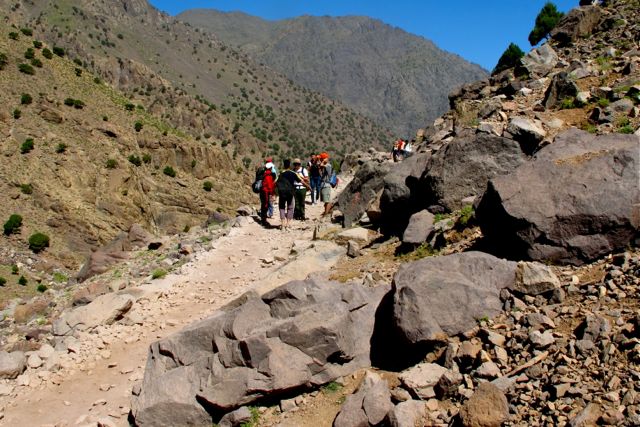
            The first day of climbing we went from Imlil to a refuge about a kilometer and a half below the peak.  The first day is a long, steep ascent, but the students had tons of energy and the hardest part for me was restraining the fastest boys from running up the mountain in their excitement.  We met some other American hikers on the trail, who you’ll see later in the story become very important.

The Refuge in Imlil
Imlil

The two girls who hadn't wanted their photos online say they've changed their minds, which means now I can post group shots!


            At the refuge we rested and recuperated with other hikers, some of whom had done the same climb we had and others who had summited that day.  One group was another student group, this one of British middle school students who were on the most awesome field trip of all time.  Their leader, an ex-military guy turned school teacher, has done extensive climbing in Nepal, so leading a group of 13 year old school kids up this peak wasn’t actually that over the top for him.  I was extremely impressed, though also a little jealous of their British public school discipline, especially when it came time for lights out.  I wouldn’t change my students for the world, but it was a reminder of one reason (besides money) that Western students tend to have more frequent and more awesome field trips than Moroccan students.  It’s way less of a logistical nightmare with students who’ll keep to a timetable.

            At the start of the second day we had a frustrating revelation.  Despite our constant reminders to bring cold weather cloths for the top three students had decided not to bring them.  The worst part, they actually had lugged jackets on the trip, but without asking us leaders had left them with some other luggage we were stowing in Imlil since it had seemed so hot at the foot of the mountain.  In good conscience we couldn’t let those three climb, so we had to leave them behind.  I guess we should have done another gear check as we started climbing the first day, but this was a mistake I hadn’t expected.

            So with eleven students and five teachers we started the difficult second day’s ascent.  It starts with a steep scree slope, and except for a couple of boulder fields continues in that vein for the whole way up.  It’s an exhausting climb through barren, black mountains that recall the entrance to Mordor.  The wind was howling most of the way up.  Still we pushed through, though at a pretty slow pace.

The Refuge on the mountain


The peak finally in sight!


            At the very beginning of the day we caught up with a group of extremely unprepared Moroccan hikers.  They were wearing very little, and carrying almost no food and water.  When we saw them they were taking a very dangerous and difficult route straight up the scree, and I had to stay behind a second to help guide the last one in the group down to a safer path with us.  The others refused to try the easier route.  The guy who did come with us eventually went on when we took a break so he could catch up with the friends who’d abandoned him.  He must have caught up at some point, because when I next saw him he had a bottle of water.  He also had lips and nails slowly turning blue in the early stages of hypothermia and his friends had abandoned him again.  Sending the kids forward to a safer ledge to take a break I opened up one of the safety blankets I’d brought and pulled out some nuts and raisins for him to snack on.  I looked ahead and was very happy to see the two American girls we’d met the day before chatting with our group ahead, coming back from an earlier summiting.  Since I’d learned the day before that they knew what they were doing I had no concerns asking them to help the man down, especially since he had pretty good English.  He was lucky they were there to take him down safely.  I was lucky they were there so that I didn’t have to forego my own summiting to bring him down.

            This Moroccan group was not the only group of fools on the mountain.  One German sounding family had brought their kids, neither of whom could be older than eight, who looked absolutely miserable as we passed them.  An Australian man came galloping down the mountain and was lucky not to twist his ankle when he tripped and fell.  All in all I guess it was good for my students to see how much they’d learned, how they knew what not to do, but the amount of dangerous practices I saw on the mountain was staggering.

            The very last part of the ascent is extremely slippery scree, made all the worse because at that point I at least was starting to feel the lack of oxygen.  We had to stop every few minutes to let ourselves catch our breaths, so it was a hard push, but eventually, just as the wind died, we were able to reach the very top.  The view is spectacular, and since the winds had finally gone down we ended up having lunch up at the very top of Morocco.  The kids now have bragging rights for life.


Our group, with some random dude sleeping in the way (we think he's the dude who abandoned the other guy lower down)


Me and my counterparts

Peace Corps Volunteers


The further town is Imlil

Kids with a Geocache
            Going down is also a tricky operation, especially since we’d never been able to practice descending a scree slope, but the kids did a fantastic job and we were able to break up our trip by finding a geocache someone had hidden about half way up the mountain.  The students were shocked to learn that some hiking obsessed Westerners play a game hiding things on mountain and leaving GPS coordinates for others to find, but were really excited once we’d found the cache.  We returned afterwards exhausted but accomplished.

            On our third day on the mountain we walked back down from the refuge to Imlil.  Once there we discovered the innkeeper with whom we’d left our stuff with was in Marrakech, two hours away.  We called her up, and I got permission to climb up a few tables and enter a high, open window, successfully burgling our own stuff from an inn I had permission and ability to enter only through the most ridiculous means possible.  A fitting end to our time on the mountain.


            After my flirtation with a life of crime we went back to Marrakech, a city I was surprised to learn almost half my students had never visited.  We took them through the raucous street theatre that is the main square and split into small groups to explore the souks.  The group I was with somehow stumbled on a shop full of antique Jewish artifacts, so now I can say I’ve explained the purpose and history of the menorah to a bunch of Moroccan students in Arabic.  Afterwards we had dinner and fresh squeezed orange juice under the stars back in the main square.

            When I told my students we wouldn’t be leaving until the following afternoon they rushed me in a football scrum of hugs.  For a second I wondered if they registered the bit where I told them we were doing this to give us time to visit an historical monument.  We took them to the Bahia palace, a place I’d visited with my parents but which even most of the students who’d been to Marrakech had never seen.  As with any group of teenagers in an historic site about half were really interested while the other half were bored out of their minds, but it was still a good trip and I’m glad I finally got a chance to make history a little more tangible for the kids.


            All in all, this trip to Marrakech and Toubkal was fantastic and easily the highlight of my service.  Since then a couple of students have told me it was the greatest thing that they’ve ever done, which I guess means I can go ahead and say I’ve had a successful Peace Corps service, regardless of what else I can get off the ground.  The Sunday after getting back to site we had an after party where the students told us how much they’d like to keep the club going, even in a non-funded form, to learn more about the environment and to keep doing local hikes together.  I’m glad I’ve had this chance to work with such a great group of kids, watching them grow both as individuals and as a team, as leaders and as good followers, and I hope to keep working with those who aren’t going to university next year, but for now we have to take a little break.  Ramadan has come.

Friday, June 28, 2013

By the Seaside


            Last week was a huge break from my regular, mountainous Peace Corps life.  I travelled down to Essaouira, a city on the coast, in order both to watch the Gnawa music festival and to work with a Moroccan anti-AIDS association, the ALCS.

            ALCS and Peace Corps have partnered together for many years at the Gnawa festival.  ALCS uses the opportunity of the festival, when Essaouira is loaded with concertgoers both foreign and domestic, to provide free HIV testing, condoms, and information from two trucks near the main stages of the festival.  Peace Corps Volunteers, along with local volunteers, pass out fliers, talk with people, and lead interested people to the trucks for testing.  People seemed very interested in talking with us, both because they don’t often meet Darija speaking Americans and because they know very little about AIDS and HIV, but are rightly terrified.  I spent a lot of time correcting misconceptions about the virus and working to convince young men that it was in their best interests to get tested.  Those free condoms turned out to be a useful bribe, though because of limitations on what Americans are allowed to do in aid work I could only lead them to Moroccan volunteers who were passing them out.

            After I’d gotten over the initial discomfort of approaching random groups of young men (I left the awkward work of approaching young women to the female Volunteers) to talk with them about AIDS the work actually turned out to be quite fulfilling.  People were mostly genuinely interested in learning, and if there was a clown in their group the rest usually shut him up so they could learn more.  Often times those who had been joking became the ones who suggested they all get tested right then.  Three moments broke the pattern and are worth talking about.  The first was when I approached a couple of older men and asked what they knew about AIDS.  They responded that they had beautiful wives and therefore didn’t need to worry about it.  Funny, but misguided.  The second happened after I’d finished talking to a group of four or five young men.  They thanked me for the information and then went about their way, but one hung back and, in a perfect Southern accent, complemented my Arabic.  It turns out he’s a programmer in the States and was back to visit family here.  We talked a little about volunteer opportunities there, which he wants to do, especially since he can try and naturalize himself soon.

            The third break from the pattern was far and away the most distressing.  Talking with a group of disrespectful young men (really the only very disrespectful group I met all day) two of them walked off and dragged over a bunch of young women who they explained were their women for the night.  They said these were the ones we should talk to.  They continued to hoot and holler as another volunteer and I explained to the prostitutes about the disease, ways to prevent it, where the testing was, and how to get in touch with ALCS.  They seemed grateful for the information even as they were intimidated by their clients.  It was a pretty disgusting moment, though I’m glad the women got the information.

            Apart from my work, last week was also the celebrated Gnawa Music Festival.  The festival (which I would really call more of a concert series, since there was only music in the evenings at a very few venues) features Gnawa, but also allows other musicians from across the world to play.  Gnawa is an interesting genre.  Like American blues and jazz its roots are in music which West African slaves brought to their new country, in this case Morocco.  Gnawa, which means black in a Tamazight dialect, is a fusion of Amizigh music with West African, and had a big influence in Morocco’s mystical Sufi tradition, where people would smoke and listen to the music for a spiritual experience.  It centers around chant like call and responses, triplet heavy rhythms, and often (though not always) a low bass instrument called a gimbari.  In many cases it also involves ecstatic dancing, sometimes even the drummers and members of the rhythm section will make gigantic leaps into the air.

            For the most part I like the recordings of Gnawa music that I’ve heard, but most of the acts at the festival left me cold.  I think a big part of the problem was with the festivalgoers themselves.  At most music festivals anywhere there are going to be a number of high people, it’s pretty much expected, but Moroccan young men on drugs seem particularly unpleasant.  Any time I went to music with female volunteers I felt worried for them, and with good reason, most of the time we left early after one too many men took liberties grabbing at the women.  The only time I was able to relax a little was the time I checked out a little of the music alone, and even then I’m glad I’d tucked my wallet into the breast pocket of my shirt, because I felt a pickpocket’s hand go into my pant pocket while his high-as-a-kite buddies tried to distract me with their singing and dancing along with the musician.  The musician playing was named Omar Hayati, which can translate to Omar the Living One.  He was fantastic, and I stayed for awhile after moving away from the pickpockets, but it was too little too late to let me really enjoy the music at the festival.

            This all sounds negative, but I actually did enjoy my time in Essaouira.  The work with ALCS was very rewarding, the counterparts we worked with fantastic, and in addition I get to spend time with a lot of other volunteers and hang out in Essaouira, a city with great food and laid back attitude.  Watching Omar the Living One was also great, it may have been the only bit of live music I enjoyed at the music festival but I enjoyed it a lot. 

Immediately after finishing work at the festival the volunteers in my training group all travelled up to Rabat together for our Mid-service training, two days where we reconvened, talked about our work, and got some further language training from Peace Corps.  I was able to get a lot of language questions cleared up, and as frequent readers know I always enjoy Rabat.  Now I’m back in site, but not for very long, soon I’ll be making the attempt up Toubkal with my C.L.I.M.B. students!

Monday, June 10, 2013

Different Worlds


            Since my last post I’ve been in near constant motion.  First I went to Rabat to attend a meeting of Peace Corps Morocco’s SIDA (AIDS) Committee.  The purpose of this committee is to create, organize, and present resources to help volunteers in Morocco counter SIDA and teach about sexual health in general, a very difficult topic to broach in this culture.  I was appointed as a representative for my stage (the group I came in with) a couple of months ago, but since the meetings are quarterly this was my first.

            The meeting went very well, and I’m excited for the extra work I was able to pick up from it, which will keep me doing something useful during the upcoming slow summer months, but what I really want to write about is Rabat itself.  I’ve talked before, and at length, about how Rabat is very different from the rest of the country, but again this hit home in my last trip, perhaps even harder than before.

            The very first thing I did this trip was finally visit the Rabat archeological museum.  The museum is small but fantastic, especially a room full of bronze sculptures from Volubilis.  During my visit there was also a school group (they were Moroccans, but, strangely, the teacher was speaking in Spanish).  I couldn’t help but think about how different these kids lives are from those in my town.  For these city kids, history is something tangible, something real, and they can see evidence of the various civilizations that have lived in Morocco.  They have something to get excited by in history.  In contrast, a few kids in my town don’t even know the Arabic word for museum.  I was talking about it with a group of students, and I know I said the word right, because about half of them knew what I meant.  The others just didn’t know what one was.

            Later, I met up with my old LCF (Arabic teacher).  As always it was a pleasure to hang out with him, but he had some bad news for me.  He has been applying to graduate school in the States, and he even got accepted to a program, but it was only at that late stage that they told him the fellowship he wanted wouldn’t be available to him until after a year of extra study because his Moroccan undergraduate degree isn’t considered equivalent to an American B.A.  Apparently one of the sticking points is that Moroccan degrees are done in three years, rather than four!  Without the fellowship he can’t afford to go, though the school says that after a year of graduate study in Morocco they’ll consider his credentials again.  This whole debacle is awful for two reasons.  Firstly, the fact that they didn’t tell him until so late that he’d need an extra credential, forcing him to spin his wheels for awhile.  Secondly, that they even need this credential and won’t instead judge him on the quality of his academic record as it stands.  I’ve read both long research papers he wrote at the end of university, and both are fantastic and of comparable quality to American undergraduate theses.

            I tell this story because it is indicative of a larger problem facing the third world, how hard it is to get out.  Qualified people like my LCF should not just be able to get out of their countries to study, it ought to be encouraged so that eventually they can come back and hopefully do much better development work than we foreign interloper Peace Corps Volunteers ever could.  The hoops people have to jump through make this very difficult, and all the people who keep pushing through and trying, like my LCF, impress me a lot.

            After hanging out and talking about Hemingway—in the last year my friend has discovered a new love for 1920s American literature, go figure—we parted ways and I met up with another acquaintance, another young, university educated Moroccan.  We talked about my experiences living in the bled (countryside) and like at the museum I was quickly reminded how different things are in the big city vs. my rural village.  A couple of weeks ago I was talking with a student in English and casually used the word “evolve,” which he didn’t know.  I explained both the sense I’d meant (something changing) and the scientific theory.  Surely, I was told, I couldn’t believe that.  I’ve since talked with a bunch of people in my town, and so far as I can tell, regardless of education level, everyone here is a creationist.  One person believed in a symbolic, rather than literal, seven days.  I don’t even know where this comes from, the seven-day creation is not even in the Quran as I recall, though it could be mentioned in a hadith or a Moroccan folk tradition.  Another believed in the possibility of animal evolution, but told me in no uncertain terms that he couldn’t believe humans evolved from animals because that would mean there was no God.  I couldn’t see the connection, but tried to explain the idea of intelligent design as a middle ground, but no one would have it.  In Rabat though my friend, a passionate Muslim, found no disconnect between evolution and Islam.  Here was a place where the divide between rural and urban Morocco lined up nicely with the divide between rural and urban America.  Perhaps a lot of the things I find so strange in rural Morocco would seem less bizarre if I came from a different part of America.

            Returning home I discovered that the scheduling issues plaguing my Toubkal climb had worked themselves out, so a counterpart and I travelled down to Marrakech to make reservations.  I’d been less than twenty-four hours home.  My counterpart and I climbed up to the refuge where we will spend the night before attempting the summit with students in a month.  The service and amenities there are pretty bad, but nothing out of line with either cheap, backpacking hostels in Europe, or cheap Moroccan tourist hotels.  Admittedly, the staff did treat us particularly poorly, at dinner they gave bread to all the tables, and the basket on our table was obviously of much older (rock hard) bread, and they wouldn’t give us any of the better bread from another table until we promised to shut up if they ate some of the stuff they’d given us.  Which they couldn’t, unless they wanted to chip a tooth.  For me, nothing of note in the world of cheap Moroccan travel, but I’m fairly certain my friend has never been more offended in his life.  Moroccans don’t stay at the same cheap hotels as foreigners do, and on the rare occasions we foreigners do stumble into a Moroccan hotel they tend to try and fleece us so the cheap tourist places end up being better.  Never having travelled with a foreigner before this was all news to my counterpart, and I think by the end of it he was as angry with how his country’s cheap tourist industry treated me as I am with how my country’s education system treated my LCF.  By the end of our two day sojourn my friend would insist I stay back whenever negotiating prices so that the person wouldn’t see me and double the price, though happily I noticed that after we got out of the trap of transportation to and from the mountain the prices my counterpart got for things were the same as what I usually get.  I wonder how much of that is people being more honest away from the mountain and how much is my Moroccan Arabic.

            In defense of the budget Moroccan tourist industry, while at times it is awful it hits the opposite extreme just as often.  Our students had asked if we could spend the night after the climb in Marrakech rather than at the foot of the mountain before heading home; we told them we’d look at the cost.  There is a budget hotel in Marrakech that gives good deals to Peace Corps Volunteers, so we swung by them first to see if we could get a deal.  I’d hoped to get a price somewhere between the ridiculously low Peace Corps price and their regular price, which would be too much money for what we have with the grant.  After explaining the project they offered us the Peace Corps price for all the students, saving us forty dirhams per person from the projected price on the grant.  Although most of these savings will find their way back into the Peace Corps country fund I’m going to ask the grant manager if I can take a little to pay the entrance fees for a landmark or two in Marrakech, see if I can’t make history a little more tangible for these bled students.